Machine-learning models estimate how long each task will take from measured productivity – and get more accurate with every completed task.
Plan
A constraint-optimisation algorithm puts every task on a suitable resource at the best moment: no overlaps, within the shift and after the preceding operations.
Connect
Receives tasks from StoreIT or any other system through standard messages and returns the finished schedule automatically.
Core product capabilities
Automatic schedules for thousands of tasks – 20,000 tasks and 150 resources in about a minute
Mandatory rules that are never broken: working hours and shifts, absences, skills per task type, no overlaps, order of dependent tasks
Priorities from 1 to 10 – more important work gets the earlier slots
Balanced workload across resources
Duration forecasts with machine learning, training settings tuned automatically by a genetic algorithm
Self-learning from completed tasks, with a separate training database and model versions
Re-planning with every new or changed request – for example a changed priority or an absent worker
Automatic delivery of the schedule with retries and an archive of every message
Manual planning cannot keep up with change
In the warehouse and on the shop floor, work changes every hour: new orders arrive, people are absent, priorities shift. A spreadsheet schedule is out of date before it is finished, and the workload of people and machines stays uneven.
PlanIT does the calculation: for every new request it builds a schedule that respects all mandatory rules and puts the important work first.
Tested at high volume
In the 2026 tests PlanIT planned a request with 20,000 tasks for a warehouse with 150 workers in six areas – receiving, put-away, picking, packing, shipping and replenishment – and 13,200 dependencies between the tasks.
20,000 of 20,000 tasks planned
0 mandatory rules broken – confirmed by an independent check
about 1 minute to build the schedule
under 8 minutes from sending the request to receiving the schedule
How PlanIT turns tasks into a schedule
Master data. The customer's system sends task types, resource pools, resources, working time and absences.
Planning request. A list of tasks is sent – type, quantity, priority and predecessor tasks.
Forecast. PlanIT estimates the duration of each task with the active machine-learning model.
Optimisation. Tasks are ordered by dependencies and priority, assigned to resources, and the schedule is improved until further improvements become insignificant.
Return. The finished schedule – start, end and resource for every task – is sent automatically to the customer's system.
Learning. Completed tasks are reported back to PlanIT and the models are retrained.
Designed to fit the existing IT landscape
PlanIT does not replace the warehouse or ERP system but works alongside it: the customer's system stays responsible for the master data, PlanIT calculates the schedule.
REST interface with standard JSON messages and full OpenAPI (Swagger) documentation with examples
Ready integration with StoreIT WMS
Results returned to an address set per customer, with delivery tracking
Clear answers for every message – which objects were accepted, which were rejected and why
Data separated between customers and warehouses
Web-based, scalable and role-oriented
Web client to review requests, tasks, schedules and the message exchange
Roles and rights for every user
Multiple customers, each with its own data and settings
Runs on a Linux server with PostgreSQL – in the cloud or on your own infrastructure
The same software in test and production
Dashboard
Master data
Requests
Tasks
Communication
Machine learning
Administration
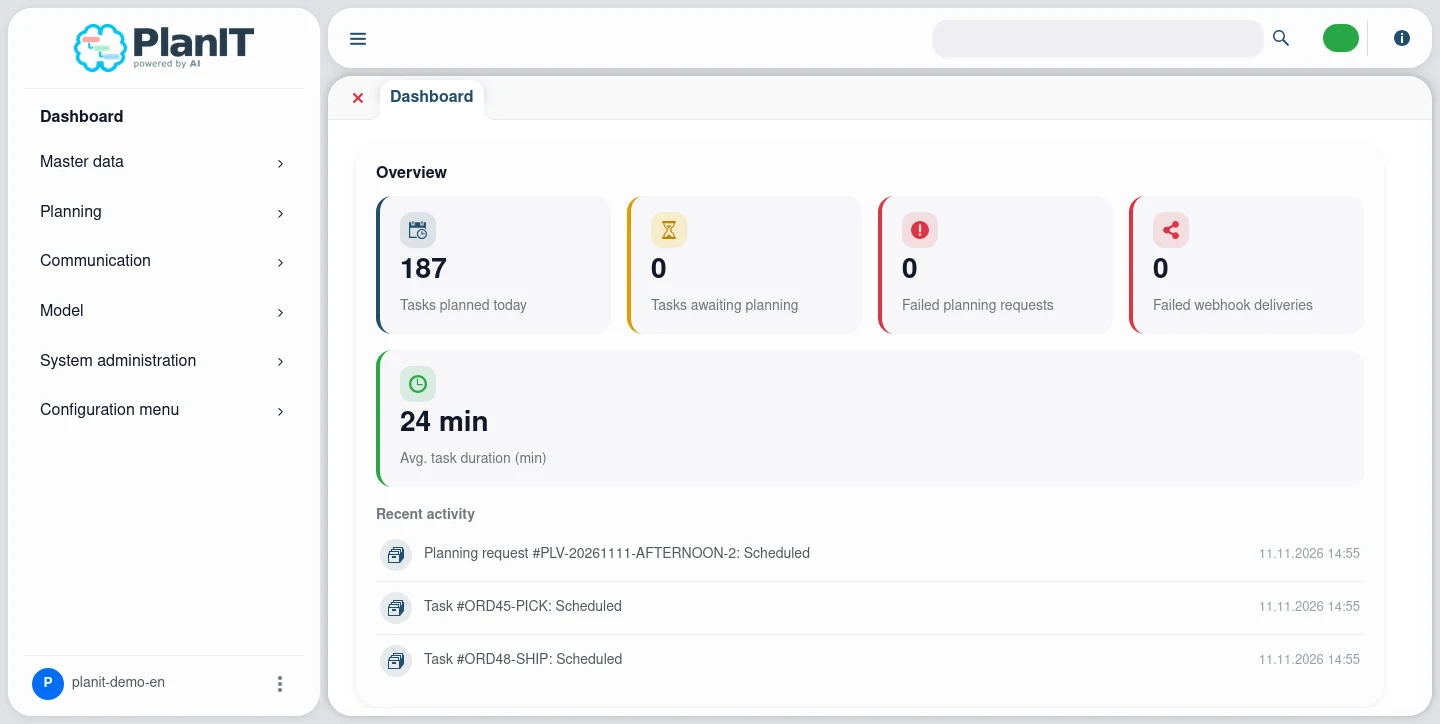
Dashboard
Dashboard
Key figures: tasks planned today, tasks waiting, failed requests and deliveries, average task duration
Recent activity in real time
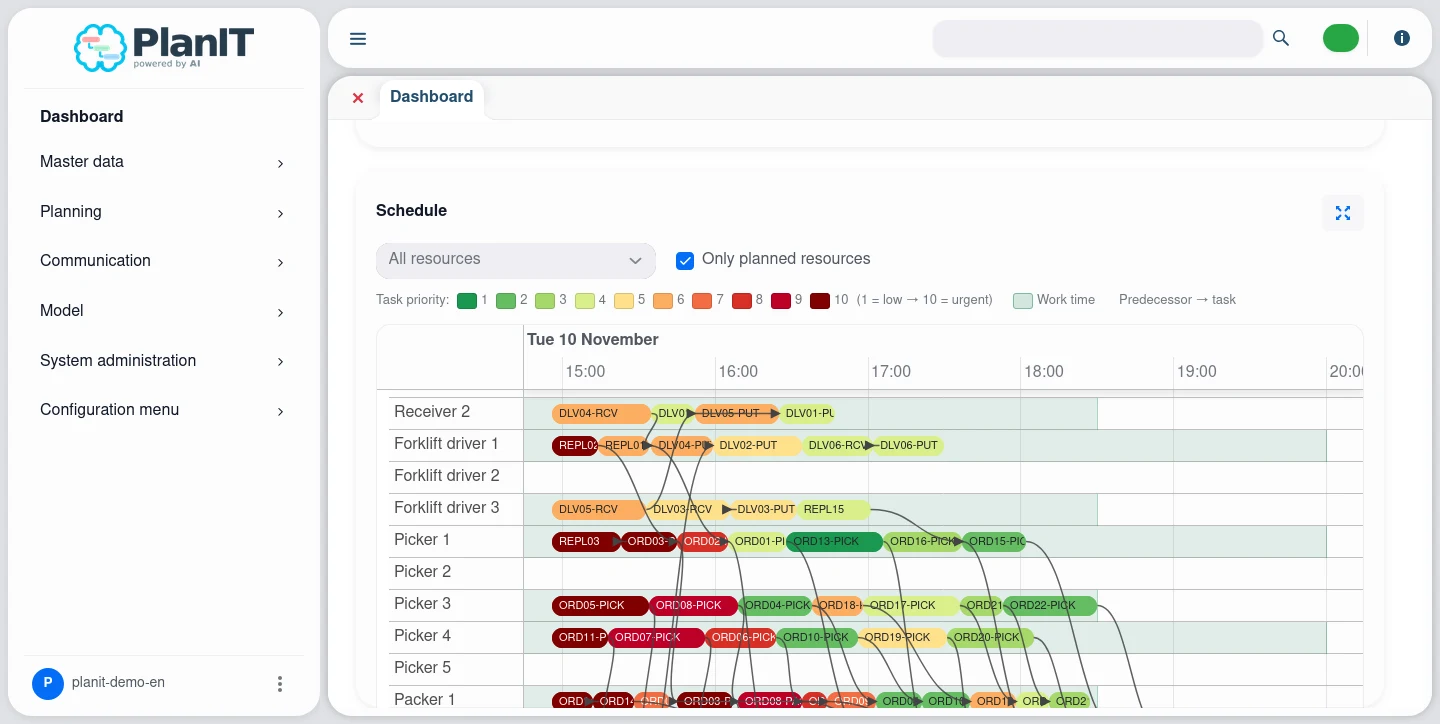
Resource Gantt chart – colour by priority, working time and predecessor → task links
Filter by resource and full-screen view
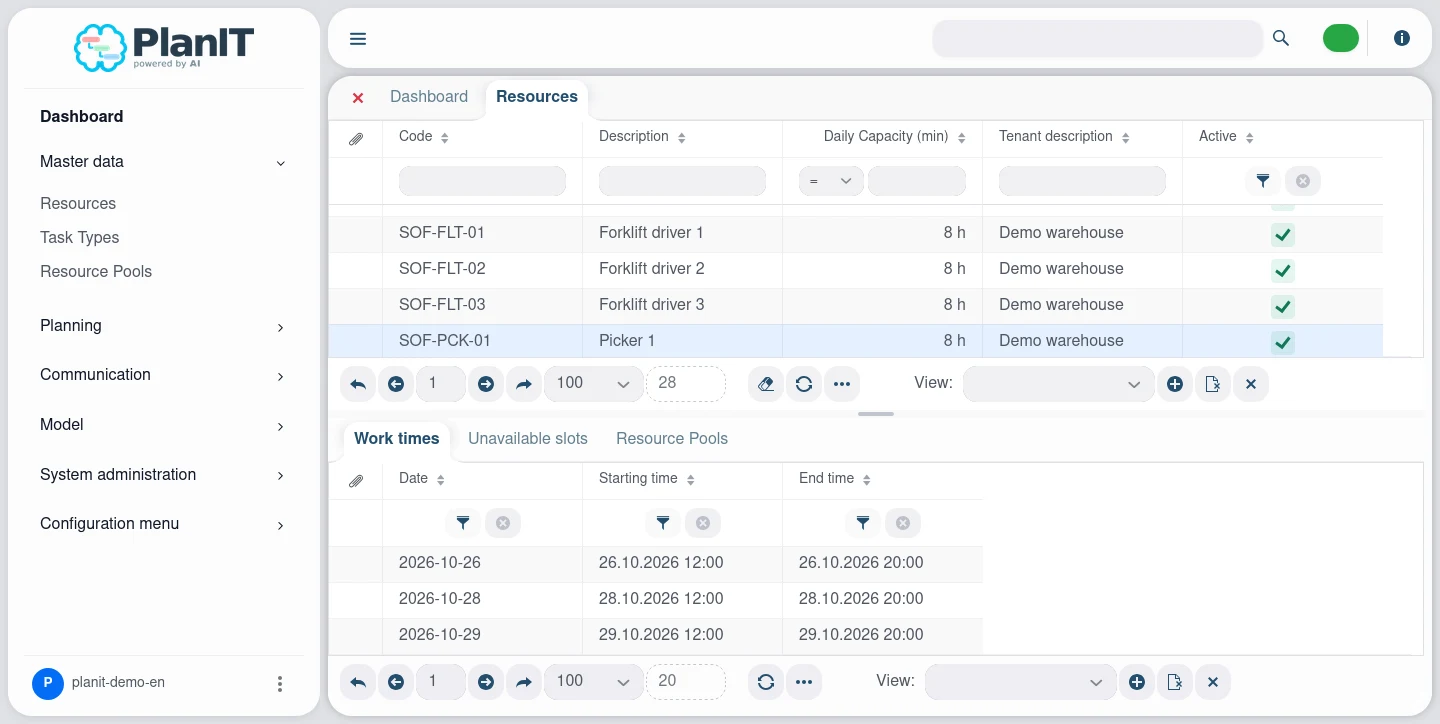
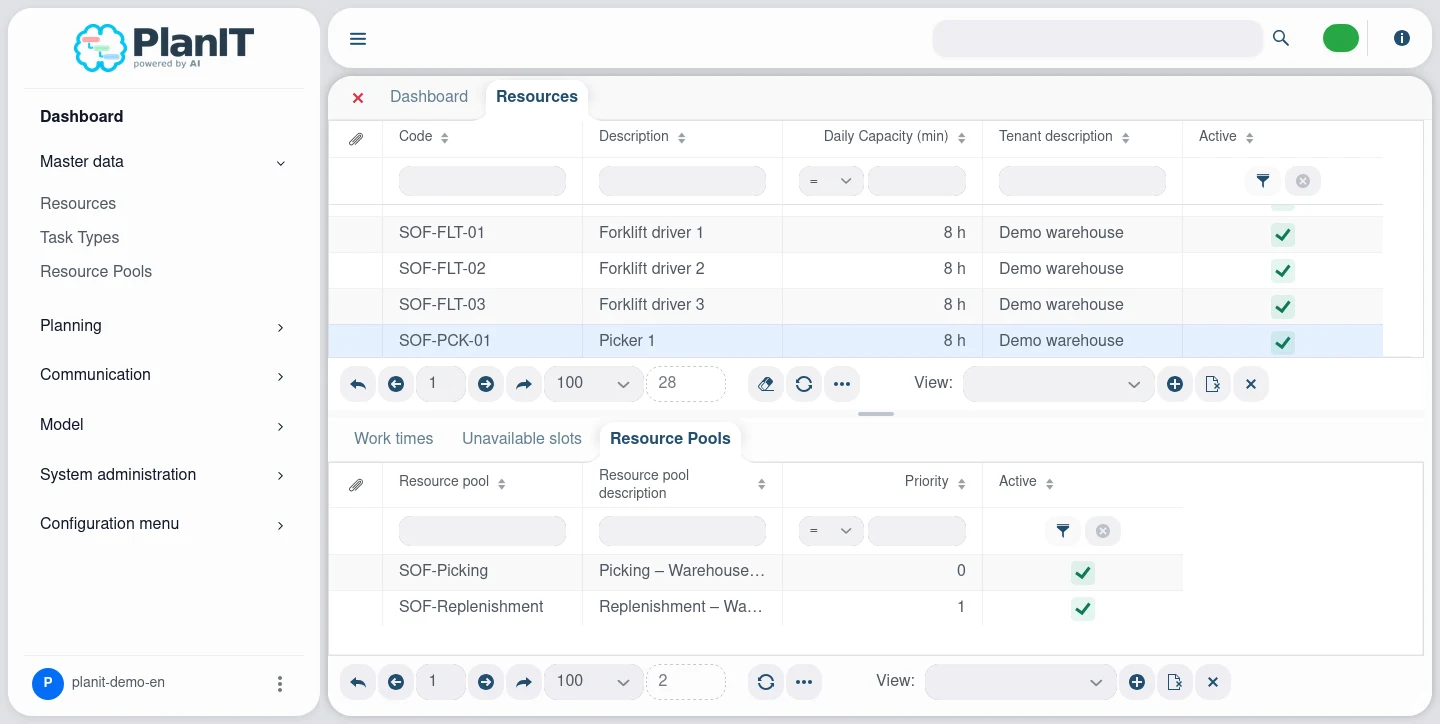
Master data
Master data
Task types for each company or warehouse
Resource pools per task type
Resources with daily capacity and pools in order of preference
Working time and unavailable periods for every resource
The data comes automatically from your system and can be checked in the client
Requests
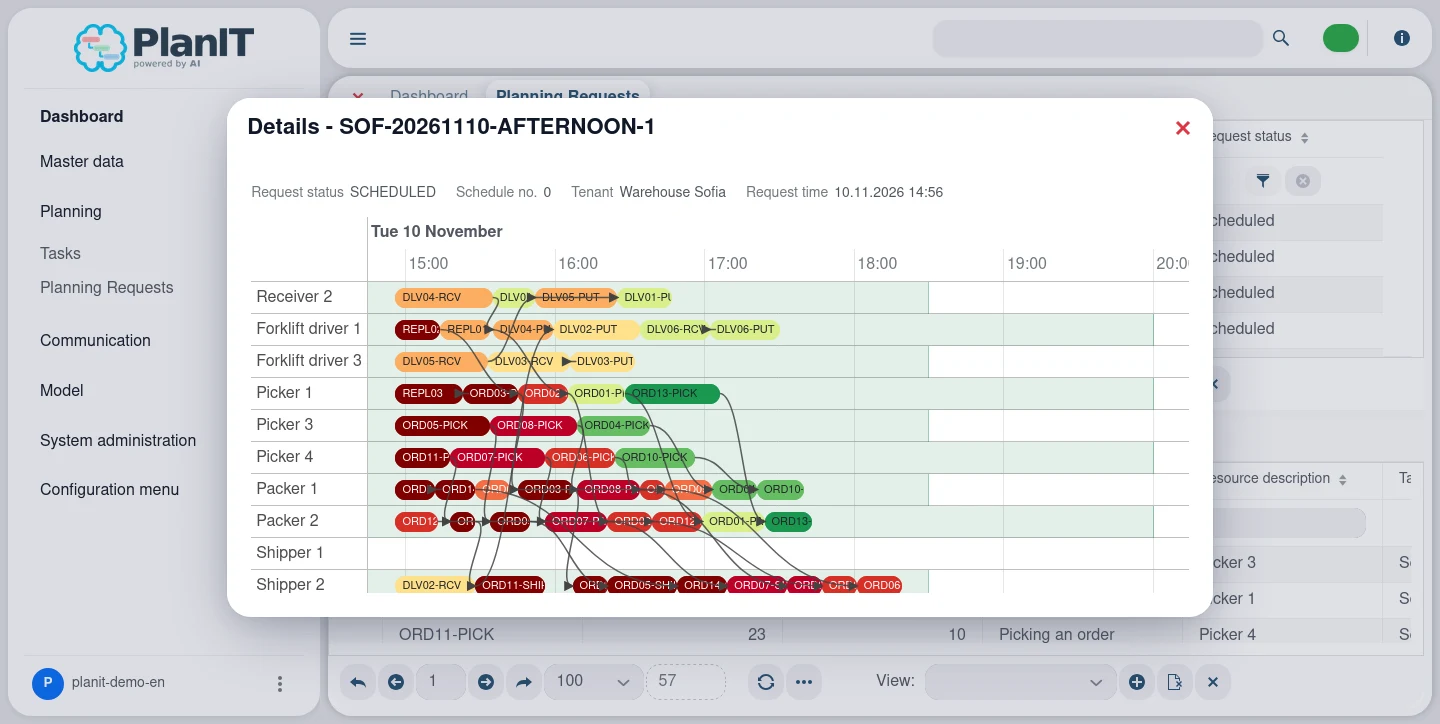
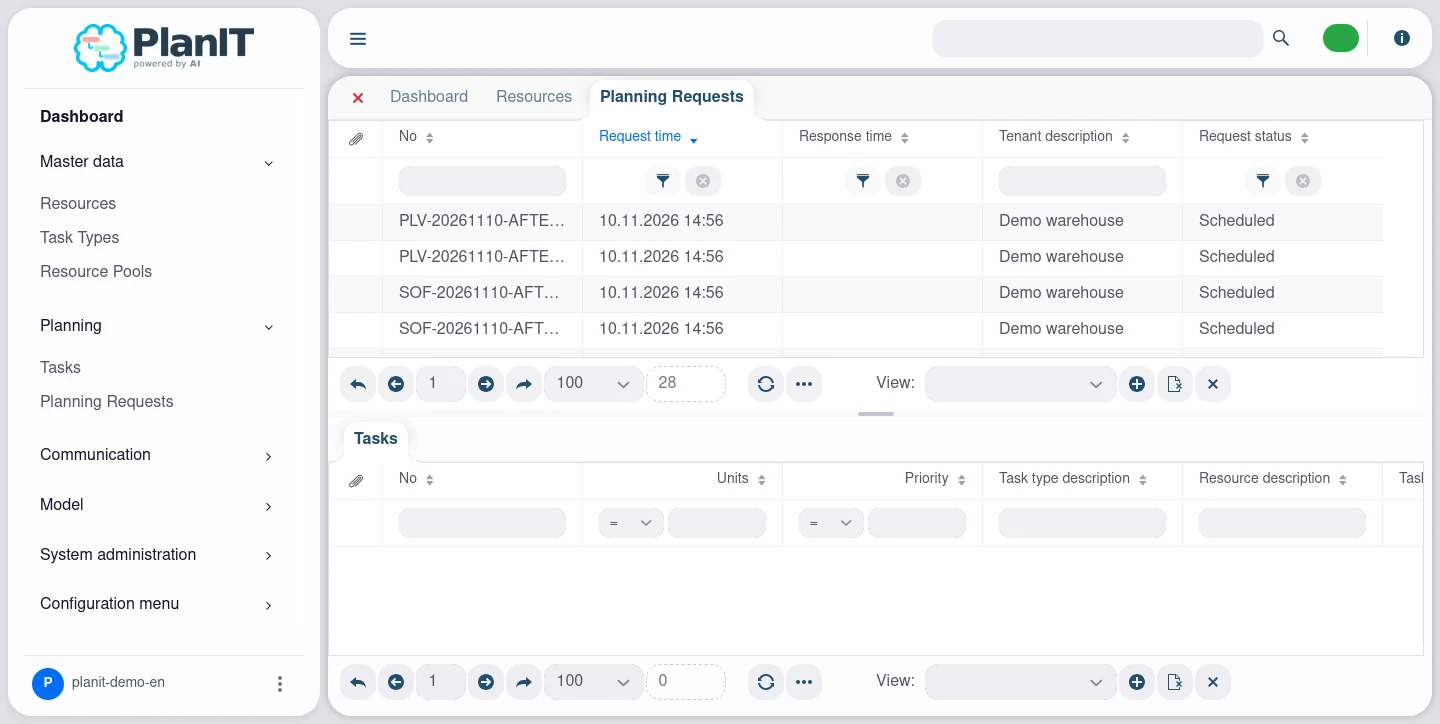
Planning requests
Every request with its status – new, in process, planned or failed
The tasks of the request right below it
Double-click opens the request’s schedule – only its tasks and resources
Re-plan a failed request in one step
Tasks
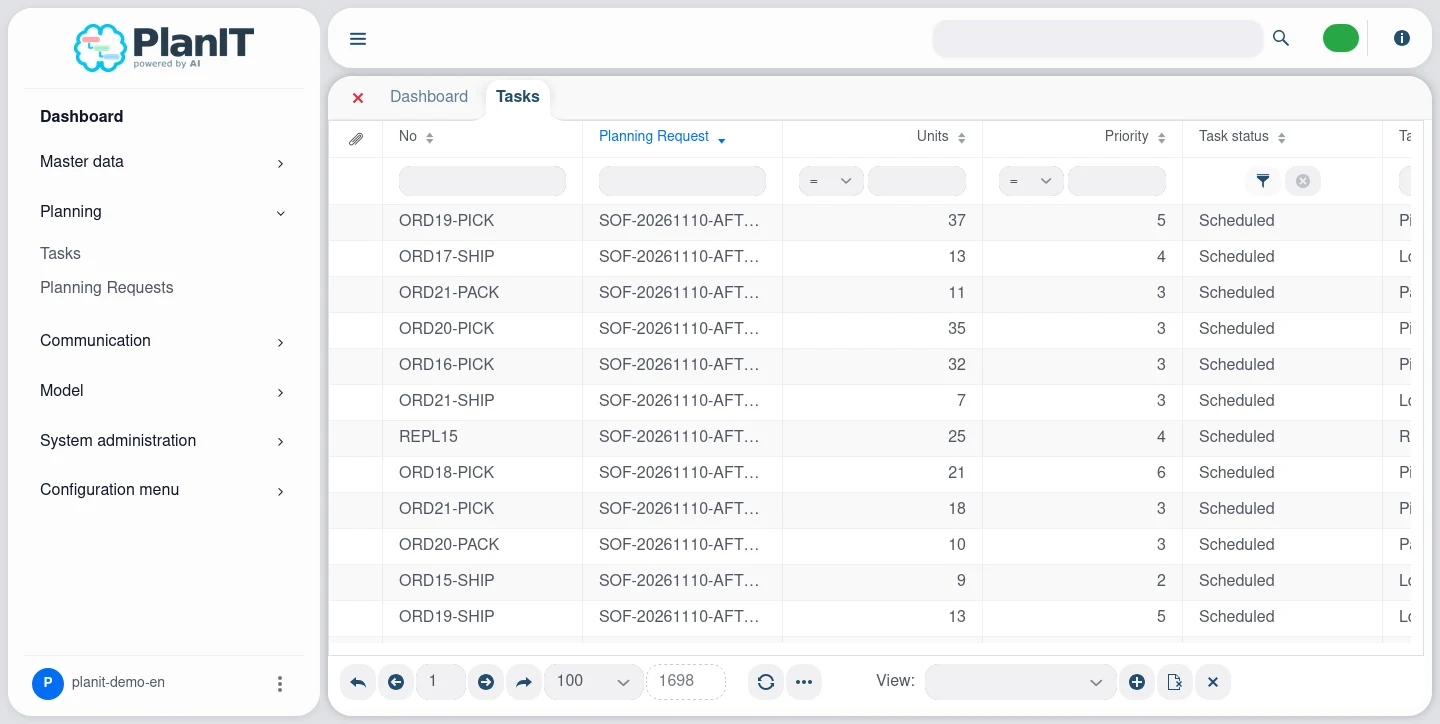
Tasks
All tasks with quantity, priority, status, resource and planned time
Filters, sorting, saved views and export
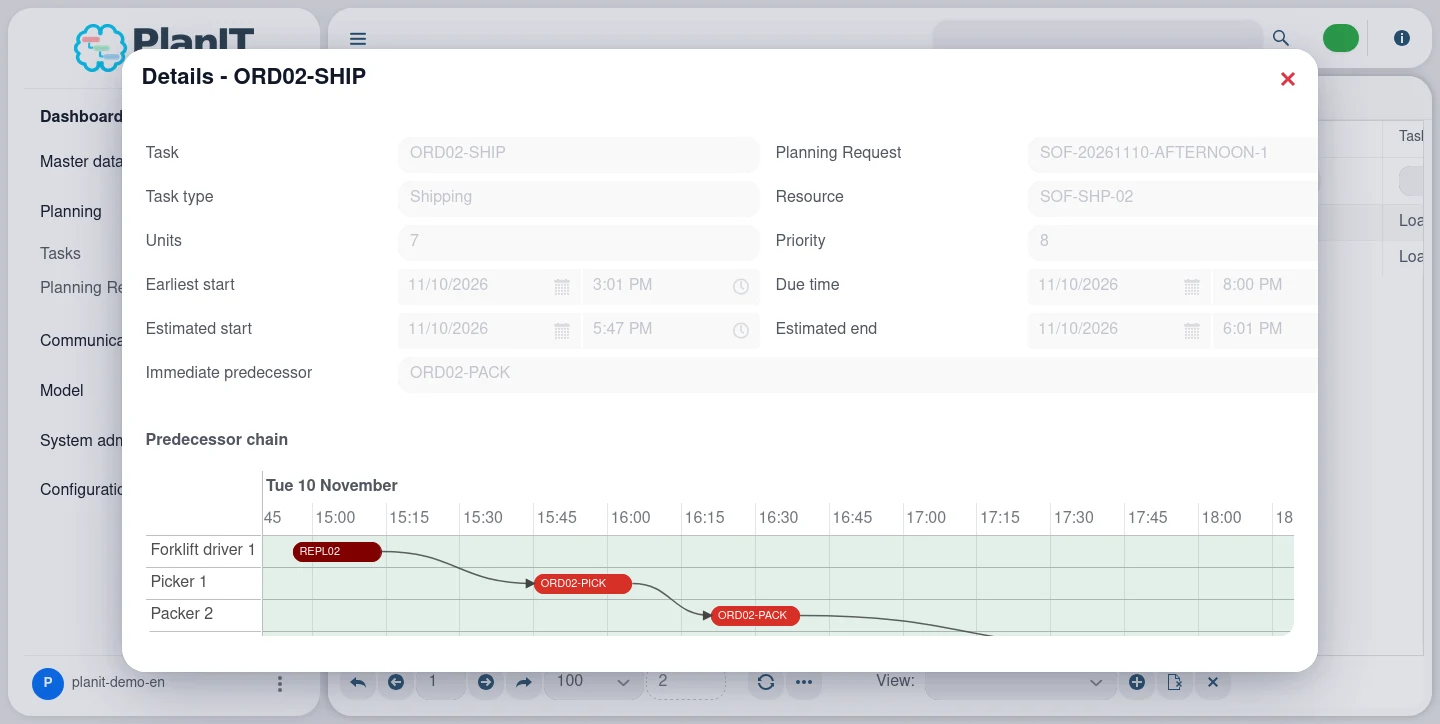
Task details with its direct predecessors
The whole predecessor chain on a Gantt chart
Communication
Communication
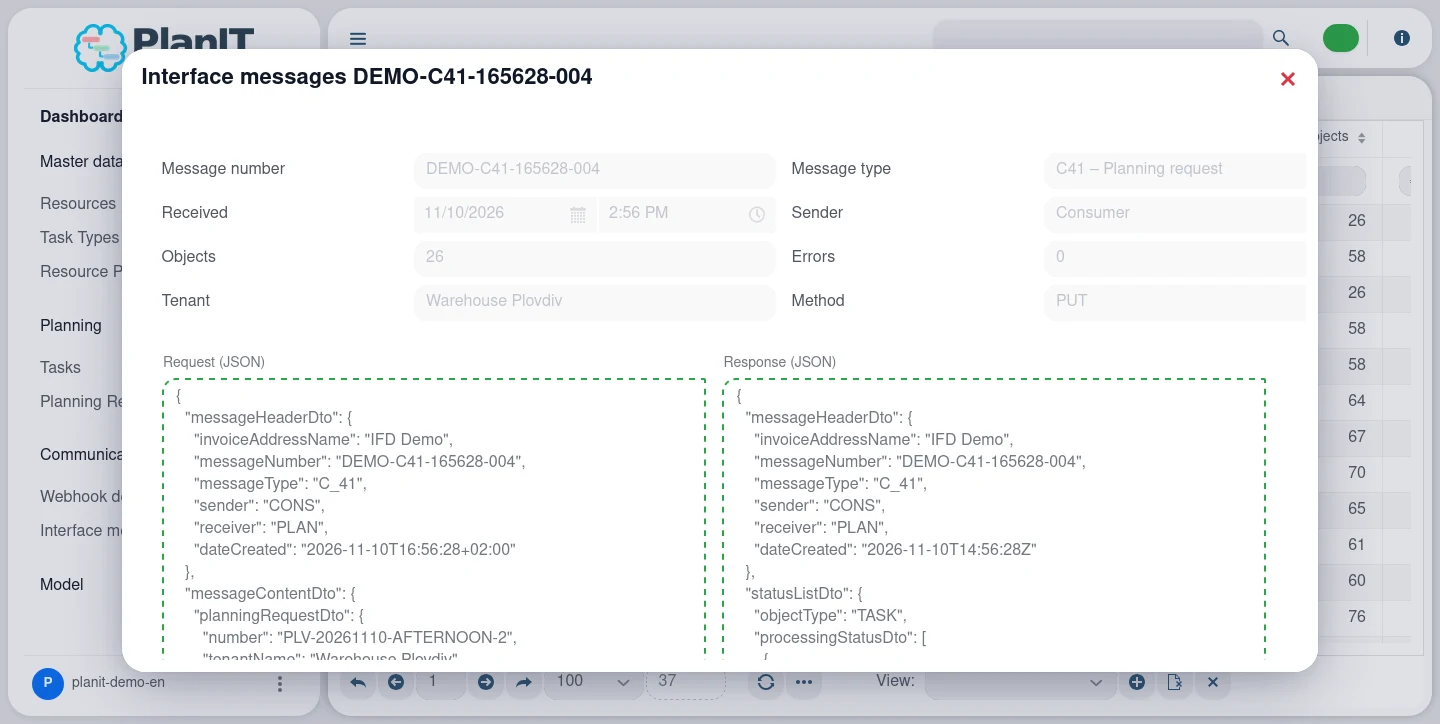
Every incoming message – status, number of objects and errors
Request and response (JSON) side by side
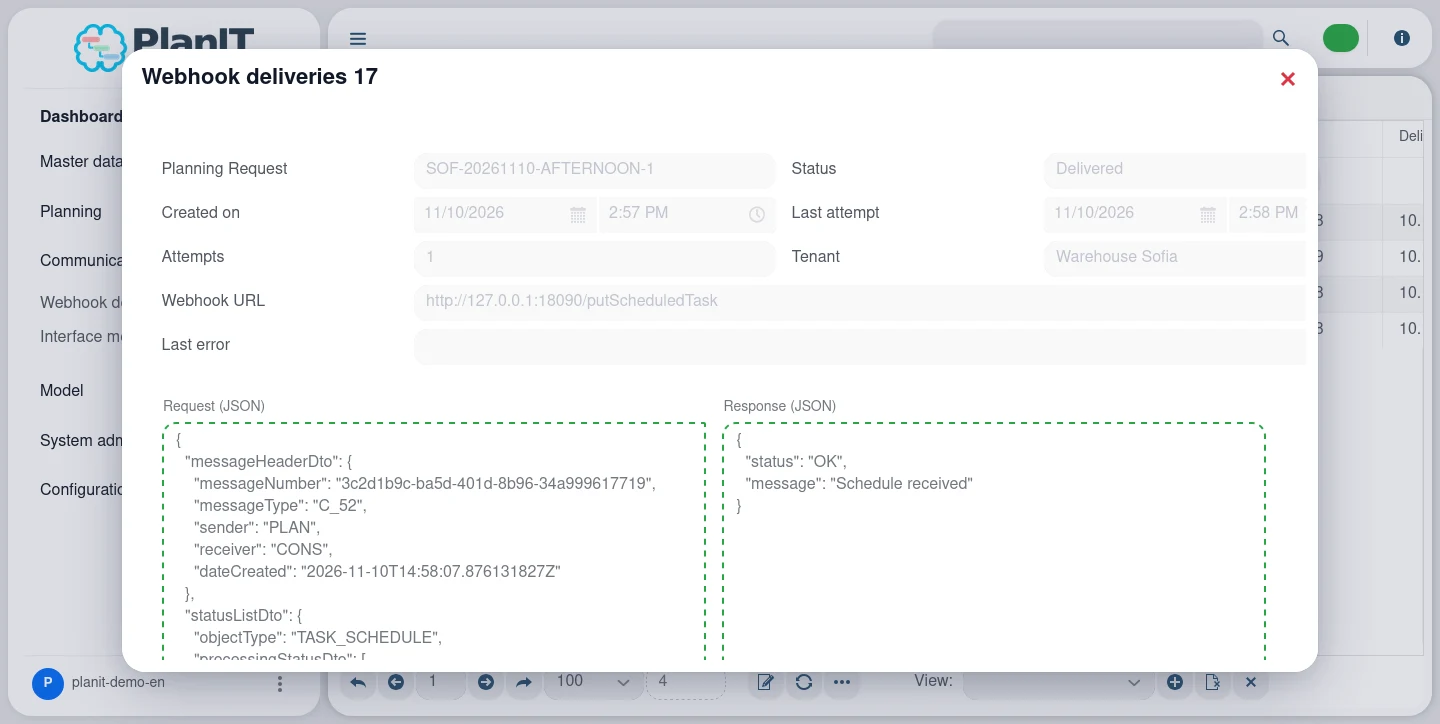
Deliveries of the finished schedules: status, HTTP code, attempts and the receiver’s answer
Automatic retries and an archive of every message
Machine learning
Machine learning
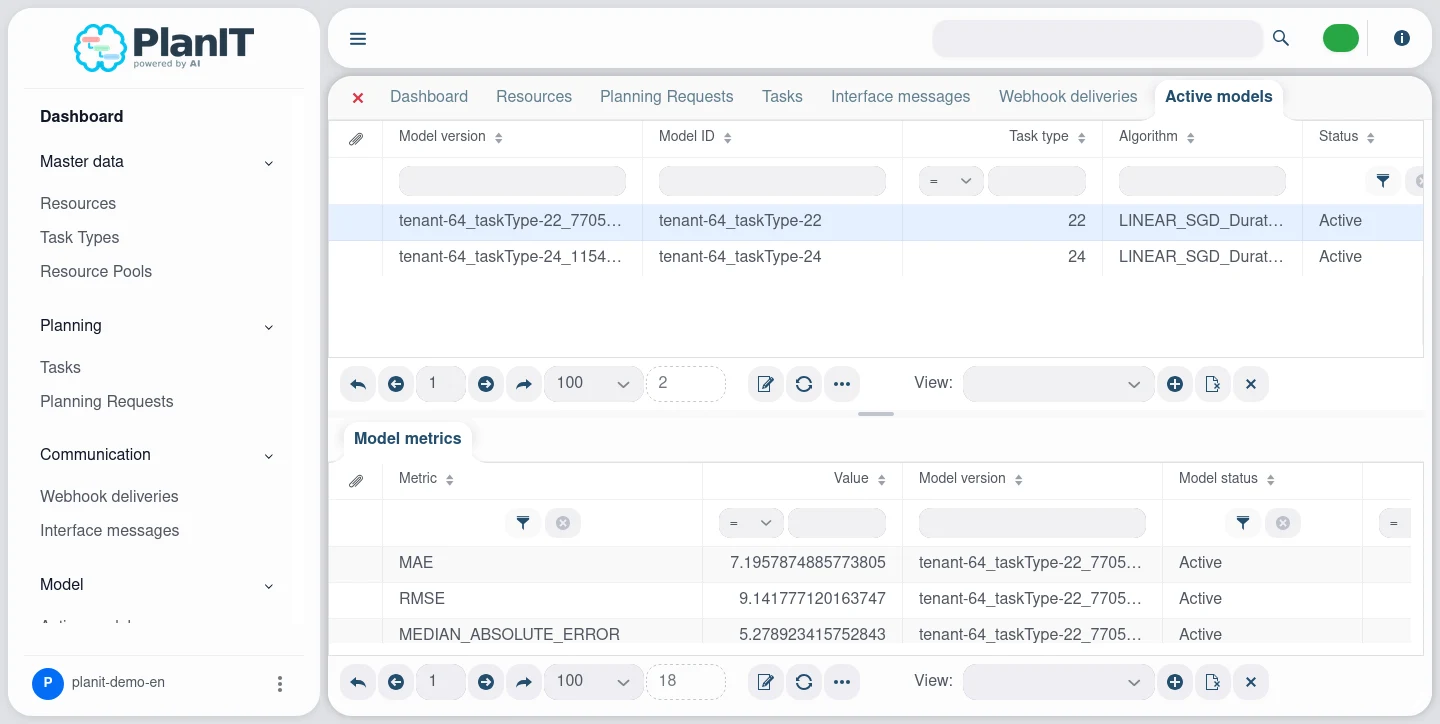
A separate model for every company and task type
Active and archived model versions
Accuracy metrics (MAE, RMSE, median absolute error)
Training settings tuned automatically by a genetic algorithm
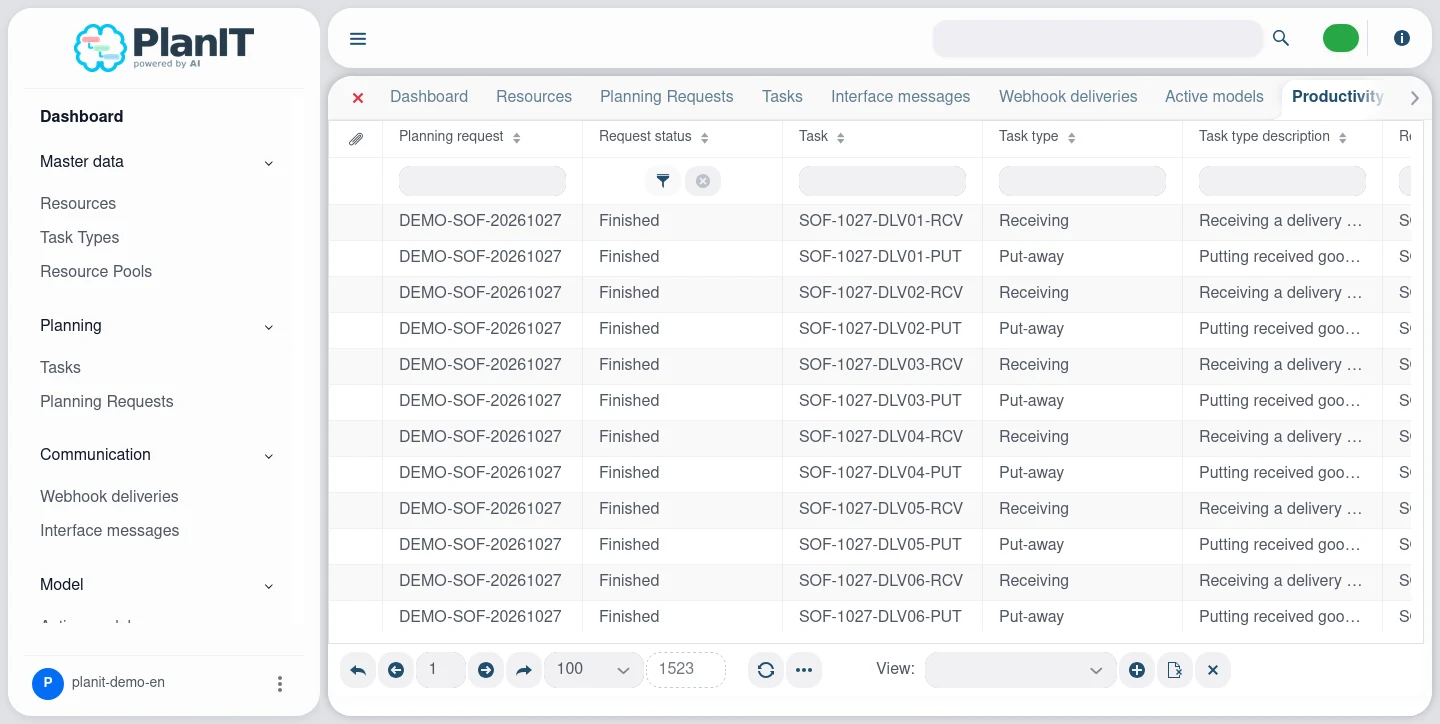
Productivity data – the actual start and end of every task, which the models learn from
Administration
Administration
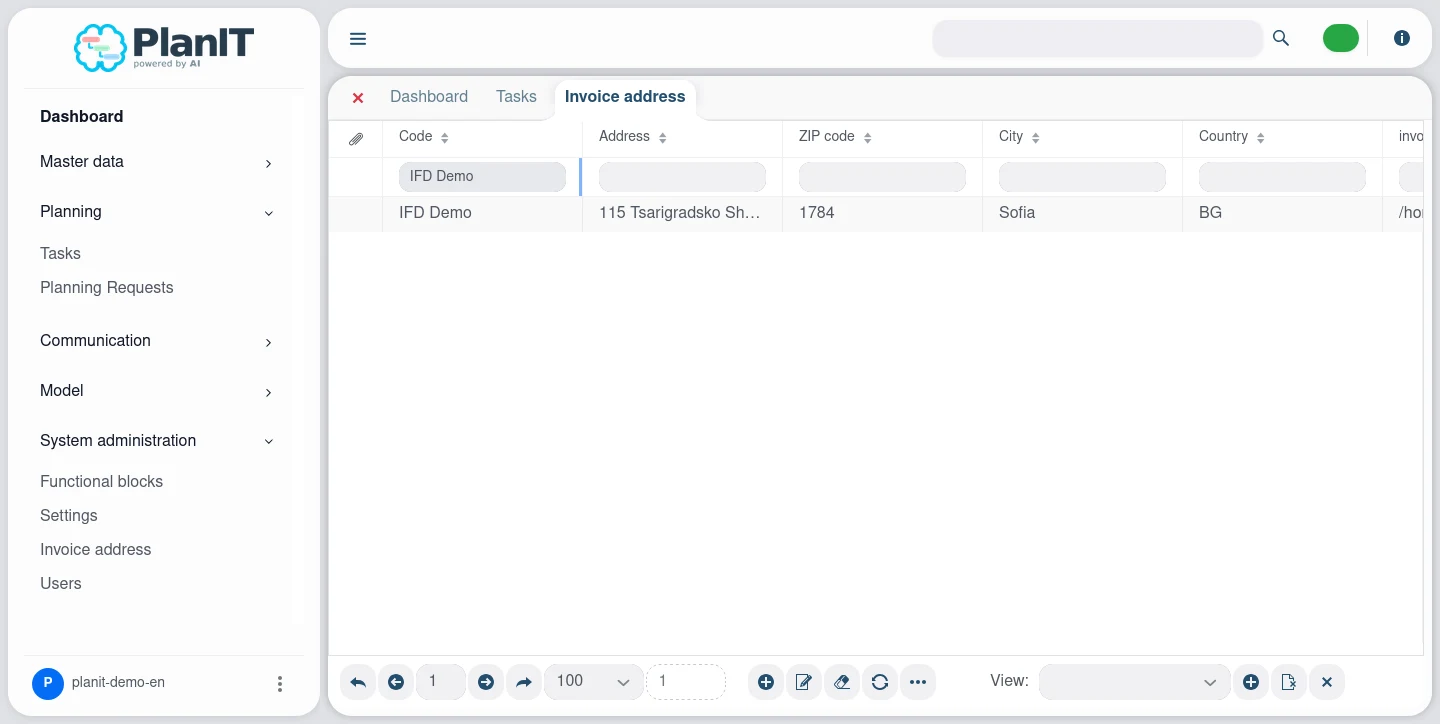
Customers (invoice addresses) and their companies and warehouses
Message archive per customer
Users, roles and rights per function block
Menus, grids and forms configured without programming
In the tests a request with 20,000 tasks was planned in about one minute.
PlanIT was developed under project BG16RFPR001-1.001-0276-C01 "Development of an innovative cloud service for planning production and logistics tasks based on artificial intelligence at IFD-ENGINEERING JOINT VENTURE Ltd", funded by the "Competitiveness and Innovation in Enterprises" Programme 2021-2027, co-funded by the European Union through the European Regional Development Fund.